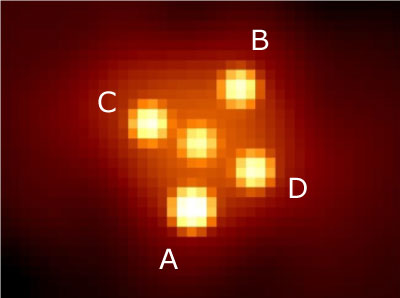
The Einstein Cross. The foreground galaxy is the object in the middle, the more distant quasar lies behind it. Lensed images of the quasar, labelled A-D, surround the foreground galaxy. Image credit: 2020 Alexey Seregeyev (Einstein Cross image), J. Marchant (labels).
A previous news item in 2020 described the collaborative project between research teams in Spain, Ukraine, Uzbekistan and Russia that used the Liverpool Telescope and the Maidanak Observatory (MT) in Uzbekistan to conduct a 2006-2019 monitoring campaign of the gravitationally-lensed quasar QSO 2237+0305, known as the "Einstein Cross" — see First detection of a double caustic crossing in a microlensed quasar.
Now a new paper by the same team has been published recently. "Joining forces: 30 years optical monitoring of the Einstein Cross" by Shalyapin, Goicoechea et al, describes how the LT and MT dataset has been extended further up to 2024, how an extra dataset starting in 1995 was added from a third telescope, and how a new photometric technique has revealed more details of the quasar source and of the lensing galaxy itself.
Quasars are extremely luminous galactic nuclei. At their centre sits a supermassive black hole weighing in at millions to billions of times the mass of the Sun, surrounded by an accretion disc of gas. As this gas falls in towards the black hole it emits huge quantities of light. Quasars have luminosities thousands of times that of a galaxy like our Milky Way.
This particular quasar, QSO 2237+0305, is about 8 billion light years from Earth, and directly in front of it is the galaxy ZW 2237+030, just 400 million light years away or 5% of the distance. Light rays from the quasar are bent by the gravity of the intervening "lensing" galaxy to form four discrete images of the quasar. These images are each much brighter than a direct view of the quasar without the effect of the lensing galaxy.
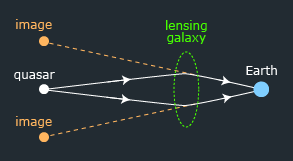
Light from a distant quasar (left) is bent by the gravity of a foreground galaxy in the manner of a lens, bringing the light to a focus at Earth (right). From the Earth's viewpoint the incoming rays make it appear that there are multiple quasars surrounding the true position.
©2020 LT Group
Because the bundles of rays forming each of the four quasar images have travelled through different parts of the lensing galaxy, they can show the additional gravitational effects of any stars passing through the rays. These extra "microlensing" effects temporarily modify the brightness of the quasar images even further.
The original news item described how one microlensing event happened between 2012-2016 when one of the four images exhibited a brightening event characteristic of an individual star in the foreground galaxy passing through the quasar image.
Since 2020, further observations have been made by the LT and MT up to 2024. The dataset was also combined with one from the 1.3m SMARTS telescope — now the Planetary Defense 1.3-meter telescope — at the Cerro Tololo Inter-American Observatory in Chile, that covered the period 1995-2024. That addition made this the longest homogenous multi-band dataset of the quasar to date, with a baseline of about 30 years.
Most of the data from all three telescopes were re-processed using a new photometric method. They found the microlensing signals exhibit sharp variations that depend on wavelength, so they can help resolve the controversy over the structure of the quasar accretion disc. Shorter wavelengths come from the inner parts of the disc, extending to longer wavelengths as the radius increases. The exact relationship with distance however is still to be determined.
This new high-resolution magnitude dataset of the microlensing events enabled the team to not only better constrain the relationship between wavelength and disc radius, but also determine the radius of the accretion disc in g band — between 7-12 light days, or 16-28 times larger than our solar system.
The new wavelength-radius relationship however differs from the standard model, leading to the possibility that the accretion disc may not be the sole source of UV-optical continuum radiation. This new dataset demonstrates that microlensing is able to reveal these deviations from a standard accretion disc scenario.
Links